

Slip Disc Treatment
Looking for the best slip disc treatment? Our spine specialists provide evidence-based physiotherapy, spinal decompression and personalised rehabilitation to relieve pain naturally without surgery.
 6,200+ Reviews Trusted by thousands.
Recommended by experts.
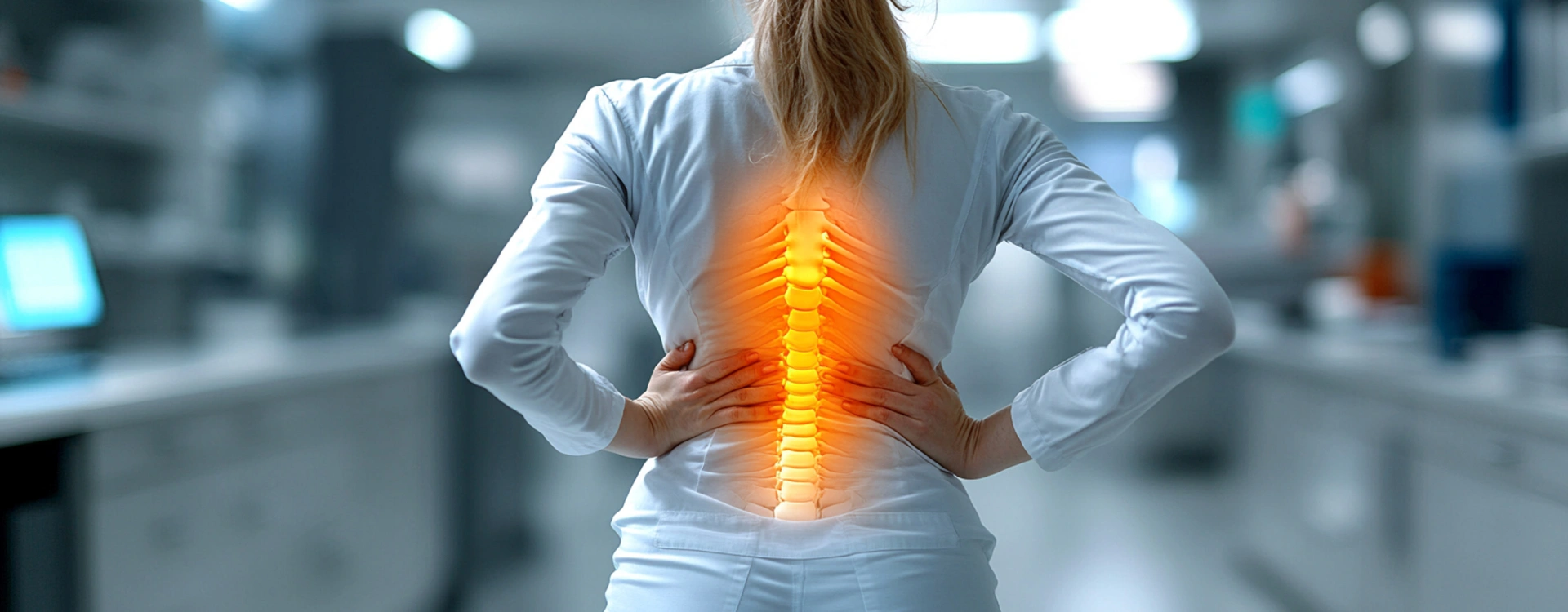
Slip Disc Treatment: Understanding the Real Cause Behind Your Pain
Do you feel a sudden, sharp, and unmistakable pain shooting through the neck or lower back when bending down? Or something like a nagging stiffness that gradually turns into pain radiating down an arm or leg. It even comes as a sudden pop with a sharp, tearing sensation in the back or neck while lifting heavy weights. All these patterns, with some others, often trace back to the same underlying issue, i.e., a slipped disc. And the first step towards an effective slip disc treatment is understanding what is happening inside the spine.
What Is a Slip Disc?
In our spine, right between every pair of vertebrae sits a disc, a small cushion with a considerably tough outer ring and a softer, more gel-like centre that absorbs shock and lets the spine bend and twist. More accurately, a slipped disc is called a prolapsed or herniated disc, and it occurs when the outer ring weakens or tears. When it happens, the softer inner material pushes outward.
Though it is called slip disc, in reality, the disc doesn’t slip out of place; the inner material shifts through a compromised outer layer. As a result, there is increased pressure on the nearby spinal nerve. Patients use several terms like bulge, herniation, prolapse, and slipped disc interchangeably, but these terms describe different stages of the underlying process.
The Stages of Disc Damage
Properly understanding the severity of this issue is really important because this shapes the overall approach of the treatment. The early stage of the issue is called a disc bulge when the outer ring has weakened, and the disc extends beyond the normal boundary. During this stage, the inner material has not broken through. When this condition progresses to a protrusion, the inner material starts to push outwards but is still contained by the outer ring. But here, the disk might start pressing the nearby nerves. A herniation or extrusion in the true sense occurs when the inner material breaks through the outer ring completely.
The most advanced stage is sequestration, when a portion of the inner material separates completely and moves within the spinal canal. The majority of the stages seen in physiotherapy fall in the bulge or protrusion stage, which can be treated conveniently with conservative, non-surgical slip disc treatment.
Why It Happens
Typically, the slipped disc develops from a combination of gradual wear and a particular triggering event. Age-related changes have been one of the major factors because spinal discs lose water content and flexibility over time, which increases their likelihood of injury under stress, a stress that can be easily absorbed by a younger and more resilient disc. Frequent heavy lifting accompanied by poor techniques (bending from the waist, not the knees) places extra pressure on the disc, and it is one of the most preventable triggers. Overweight, prolonged sitting, smoking, and a sedentary lifestyle also contribute to this issue, as each of these factors either adds direct load or reduces the ability of the disc to stay well-nourished and resilient over time. Then there is sudden trauma caused by a fall, car accident, or something else that can also cause slip disc even in the most healthy spine.
How It Shows Up
The symptoms here are a bit complicated because they depend mostly on the location of the slipped disc in the spine and how much pressure it puts on the nearby nerves. A slipped disc in the lower back leads to a sharp or burning pain in the lower back, buttock, or leg, and sometimes follows the path of the sciatic nerve down to the foot.
The same problem in the neck causes more pain and stiffness, or even a radiating sensation into the arm, shoulder, and hand. In some cases, mild muscle weakness is also common in the affected limb because additional pressure on the affected nerve interferes with the signals it carries.
The pain usually worsens with specific movements like prolonged sitting. Coughing and sneezing impact the pain as well because it increases the pressure on the spine momentarily.
Who’s More Likely to Develop One
Some factors make slip disc more likely. Those between their thirties and fifties are at higher risk because during this phase, disc degeneration accelerates, and the physical activity levels are relatively higher. People who are in occupations that involve repeated bending, heavy lifting, and twisting face more risk. Those with sedentary desk-based roles are more likely to have it as well, but for a whole different reason, i.e., sustained pressure on the lower spine. Excess body weight can be a major factor, along with a family history of disc-related problems. It has been found that men are affected by this problem more frequently than women.
Warning Signs That Need Urgent Care
Even the most painful cases of slipped discs respond pretty well to modern physiotherapy without requiring emergency treatment. But some specific and rare complications occur when a large disc herniates centrally and ends up pressing a bunch of nerve roots (cauda equina) that control the sensation and function of the bladder. If these nerves get significantly compressed, it leads to cauda equina syndrome. Some of the warning signs of this complication are:
- Sudden loss of bowel or bladder control
- Numbness in the inner thighs, groin, or genital region, which is sometimes described as saddle numbness
- Progressive weakness in one or both legs
- Severe pain that does not improve and keeps worsening regardless of rest
The good news is that, in most cases, physiotherapy-based slip disc treatments have proved to be highly effective and appropriate.
Confirming the Diagnosis
The diagnosis here is a bit detailed as experts take a look into the clinical history while they perform physical examinations, test reflexes, muscle strength, and certain movements to pinpoint the problem. Unlike general neck pain or back pain, slip disc diagnosis relies heavily on advanced imaging to precisely identify the stage and location of the disc. Initial X-rays might be helpful for ruling out irrelevant causes, but MRIs are more effective in giving a clear picture of the stage of disc material.
Importance of Physiotherapy In This Regard
Physiotherapy-based slip disc treatment focuses on relieving pressure on the affected nerve and supports the natural healing process of the spine. With the help of specific stretches and nerve mobilization techniques, the irritation is eased, and normal movement is restored gradually. Since the issue is structural, not muscular, strengthening exercises for the core and back reduce the ongoing load on the disc that has been affected.
Commonly, tightness surrounding the muscles develops because the body compensates for the pain, which is addressed effectively by manual therapy. Once the recovery is complete, posture and movement re-education is provided to make sure that the individual does not repeat the same pattern. Most patients whose discs are at either the bulge or protrusion stage find relief from a combination of the above-mentioned techniques without requiring surgery.
Treatment at Painflame
The slipped disc treatment at Painflame initiates with a thorough assessment in order to confirm the stage and location of the disc. Further decisions are made based on this examination. Experts here gradually reduce the pressure from the affected disc with the help of manual therapy, targeted exercises, and spinal decompression therapy. Our team works to ensure proper healing based on the specific condition, which eliminates the need for surgery in most cases, and patients are able to get adequate improvement.
What Recovery Usually Looks Like
The majority of the people with slip disc issues visiting our clinic see meaningful improvement within four to six weeks of sustained physiotherapy. When the case has advanced further into true herniation, it may take about eight to twelve weeks or even longer. With the help of the right care and natural functions of the body, the proportion of herniated discs reduces in size, and the immune system breaks down the displaced material. But symptom relief and disc shrinkage don’t happen at the same rate, and an effective treatment plan takes this complexity into account. Hence, the treatment plan keeps on working while confirming the progress with the help of advanced scans rather than focusing only on the pain.
Reducing the Risk of a Slip Disc
The slip disc issue is deeply linked with disc health and spinal load, which means that prevention relies on protecting the spine on a daily basis. Easy changes often make the biggest impact, like using the right lifting techniques taught by experts that prevent excessive pressure, which triggers disc injury; continuing with the strength training exercises; keeping body weight under control; and avoiding smoking.
Painflame offers a perfect blend of expertise and cutting-edge tech to ensure that the treatment is highly effective every time. Whether it be spinal decompression therapy or other techniques, this clinic ends up offering the best slip disc treatment in Gurgaon. You can find more on our slip disc treatment page.
Frequently Asked Questions
Is there a chance that slip disc will heal on its own?
After a certain level, herniations rarely resolve on their own. Structured treatment is a must in most cases. Whenever you feel symptoms, a thorough diagnosis is the best first step.
Am I going to need surgery for my slipped disc?
Not necessarily. The majority of herniations improve with physiotherapy, and surgery is considered only when the underlying issue does not improve after completing the conservative treatments.
Is it possible for a slipped disc to happen in the neck, like the lower back?
The lower back is the most common site for this issue. But slip disc may occur in the neck as well, with symptoms like stiffness, pain, or radiating symptoms in the shoulder and arms.
Will it be safe for me to exercise with a slipped disc?
Not without an expert’s help. They can ensure guided movements that will be safe and beneficial for your particular condition. Inappropriate exercise may complicate the condition further.
How can I prevent a slipped disc from coming back?
To prevent recurrence, maintain good posture, strengthen your core muscles, avoid heavy lifting, and make ergonomic adjustments in your daily routine.
Patient Feedback & Success Stories
Treatments
Our Services
Our doctors
Meet more Painflame specialists






Dr. Divakar Kumar
Sports Rehabilitation, Sports Injury Management, Musculoskeletal Rehabilitation, Performance Enhancement, Strength & Conditioning
Book Appointment
Dr. Jaya Sharma
Pilates Expert | Musculoskeletal Rehabilitation, Sports & Pelvic Floor Specialist
Book Appointment

Dr. Priyanka Bhuyan
Tailbone (Coccyx) Treatment, Chiropractic Care, Spine & Joint Rehabilitation
Book Appointment
Dr. Saksham Kapoor
Sports Physiotherapy, Musculoskeletal Rehabilitation, Pain Management, Injury Prevention & Recovery
Book AppointmentLatest Blogs
Neck Stiffness: कारण और 5 मिनट की एक्सरसाइज से राहत
गर्दन की अकड़न (Neck Stiffness): कारण और 5 मिनट की एक्सरसाइज से राहत क्या सुबह उठते…
Read More
Navel Displacement: लक्षण, पहचान और उपचार
क्या आपको अक्सर पेट में अनजान दर्द रहता है? क्या खाने के बाद ब्लोटिंग, गैस या…
Read MoreCore Strengthening Exercise जो कमर दर्द को जड़ से खत्म करे
क्या लंबे समय बैठने के बाद कमर दर्द होने लगता है? क्या सुबह उठते ही पीठ…
Read More