

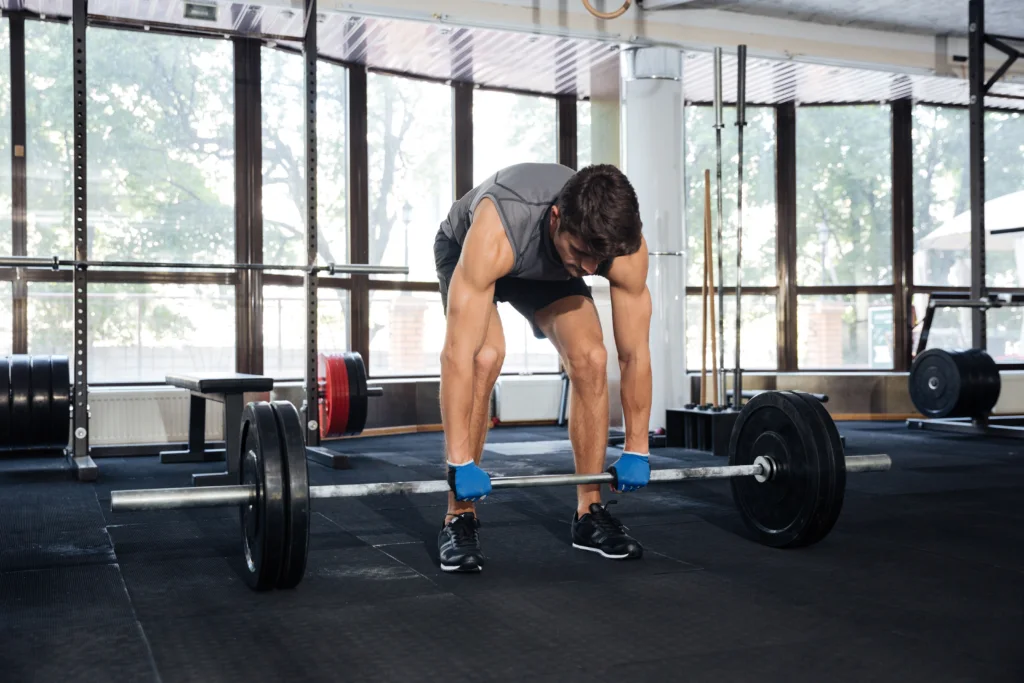
| TL; DR: Deadlifts place substantial load on your lower back, but that does not always mean heavy lifting leads to a slipped disc. Back pain after a workout can have several causes. Learning to recognise concerning symptoms, managing your training and returning to exercise gradually can make a real difference. |
Say your lower back aches after a heavy set of deadlifts. Soon you’re wondering, “Was the weight too much, or have I slipped a disc?”
It’s not an uncommon concern to have, as 1.0–4.4 injuries occur for every 1,000 training hours in powerlifting. So, while injuries do happen, the back pain after lifting can also come from tired muscles or an irritated nerve. The key is knowing which symptoms matter and what to do next.
How you lift matters, but it is only part of the picture. Let’s look at what actually happens to your back during a deadlift, which symptoms deserve attention and how you can get back to lifting after an injury.
Can Deadlifts Cause a Slipped Disc
Deadlifts can contribute to a lower-back injury if the weight or training demands exceed what someone can manage. A slipped disc, also called a herniated disc, occurs when disc material extends beyond its normal boundary. It can irritate nearby nerves, sometimes causing pain that travels down the leg.
Heavy lifting is one possible trigger. At heavy, near-maximal loads, deadlifts can place compression forces of 5–18 kilonewtons (kN) on the lower back. But disc problems can also develop without a single obvious injury, with age, genetics and physical conditioning also influencing your risk.
This is why a weight that’s manageable for an experienced lifter may be too demanding for someone who hasn’t yet built the strength or control to handle it.
Does a Rounded Back Mean You Are Damaging a Disc
You’ve probably heard the advice to keep your back perfectly straight when deadlifting. But a little rounding isn’t necessarily a problem, and trying to hold your spine completely rigid isn’t the goal. It’s more important to lift a weight you can handle and stay in control throughout the movement.
A 2020 systematic review offers some perspective here. Most of the studies examined found no significant difference in lumbar bending between people with and without lower-back pain. So, there’s no need to panic every time your lower back curves slightly during a lift.
What you should pay attention to is how your technique changes as the set gets harder:
- Start with a weight you can manage and don’t rush towards heavier plates.
- Build strength over time by increasing the resistance gradually rather than sudden jumps.
- Don’t ignore fatigue if you’re struggling to control the bar. Just end the set.
How Can You Tell Muscle Soreness From a Slipped Disc
Lower-back pain after deadlifting can come from muscle soreness, a strain or irritation of a spinal nerve. Soreness that develops a day or two after training often settles with recovery. Pain shooting down a leg, tingling, numbness or weakness deserves closer attention because these can be symptoms of sciatica.
The timing and location of your pain often point to the likely cause. Delayed-onset muscle soreness typically develops one to three days after intense or unfamiliar exercise and gradually improves. Nerve-related pain often follows a different pattern, sometimes traveling from the buttock into the leg or foot.
The following table will help you understand what it could be:
| Symptoms | Possible Cause | What to Do |
| Dull muscle ache or stiffness starting 1–3 days after exercise | Delayed-onset muscle soreness (DOMS) | Reduce training intensity and keep gently active. Soreness usually improves over several days. |
| Sudden, localised lower-back pain during lifting, sometimes worse with movement | Possible muscle strain or nonspecific back pain | Stop the painful lift. Seek assessment if pain is severe, worsening or interfering with daily activities. |
| Sharp, shooting or burning pain travelling from the buttock down one leg | Possible sciatica or nerve irritation | Arrange a clinical assessment if symptoms worsen, persist or limit normal activities. |
| Tingling, numbness or new weakness in the leg or foot | Possible nerve involvement | Seek prompt medical assessment, particularly for new weakness. Rapidly worsening weakness needs urgent attention. |
Pay attention to when the discomfort began, where it travels and whether your strength or sensation has changed. These details help a physiotherapist or doctor assess the problem. A clinical examination may include checking your leg strength, sensation and reflexes to look for signs of nerve involvement.
What Should You Do If Your Back Hurts After Deadlifting
If your back hurts during a deadlift, stop the painful set instead of testing it with more repetitions. Seek assessment if symptoms are severe, keep returning or begin travelling into your leg. NICE guidance encourages people with low-back pain to remain active where possible, which can be brisk walking, lighter exercise or a temporary change to your gym routine.
The aim is to keep moving without repeatedly provoking symptoms. That can mean making a few simple changes to your next sessions:
- Swap the aggravating lift and choose exercises that let you train without worsening the pain.
- Keep an eye on changes and notice whether discomfort spreads or begins affecting normal activities.
- Get professional care from a clinician if the pain persists.
Can a Slipped Disc Heal Without Surgery
A slipped disc doesn’t always mean surgery is around the corner. In fact, the World Federation of Neurosurgical Societies (2024) reports that 60–90% of symptomatic lumbar disc herniations resolve spontaneously. The body can gradually absorb some of the displaced disc material, and symptoms often improve as this happens. For most people without serious nerve problems, treatment focuses on managing pain and gradually getting back to normal activities.
How Can Physiotherapy Help You Return to Deadlifting
Physiotherapy for back pain can include strength training, not just stretches or gentle exercises. A physiotherapist can assess your symptoms, choose exercises you can manage and increase resistance over time.
In particular, there’s research supporting the use of lifting exercises in rehabilitation. A 2016 randomised trial of 70 people with mechanical lower-back pain compared high-load lifting with low-load motor-control exercises and found improvements with both. Clinical guidelines on physiotherapy and exercise progression support an individualised approach to recovery too.
A typical progression might look like this:
- Start with simple hip-hinge movements to groove the pattern.
- Introduce lighter weights once you can move comfortably.
- Build resistance gradually, without rushing back to your previous personal best.
Conclusion
Heavy deadlifts are demanding, but they are not automatically harmful to your spine. Injury risk depends on the person, the load and how training is managed. If back pain develops, recognising symptoms early and adjusting your workouts is more useful than assuming you’ve permanently damaged a disc.
A slipped disc doesn’t necessarily mean giving up the gym. If pain is persistent or you’re unsure how to return to lifting, Painflame brings you physiotherapy professionals for a thorough assessment and rehabilitation guidance. The goal is to get back to movement with a plan that’s best suited for you.
Frequently Asked Questions
Can I deadlift with a herniated disc?
Deadlifting with a herniated disc may be possible once your symptoms are improving and you can handle the movement comfortably. However, you should never jump straight into heavy conventional deadlifts off the floor with an acute or unmanaged disc injury. But it’s best to exercise caution until you are pain-free and get a medical professional’s opinion.
Do I need an MRI after hurting my back during a deadlift?
An MRI is not routinely needed for uncomplicated lower-back pain. A healthcare professional may recommend imaging when there are serious warning signs or when the findings would change treatment. Your symptoms and examination help guide that decision.
Can a lifting belt prevent a slipped disc?
A lifting belt may help you brace during heavy exercises, but it hasn’t been proven to prevent slipped discs. A belt is not a substitute for choosing a manageable load and controlling the movement.
Can a disc bulge show up on an MRI without causing pain?
Yes. A 2015 review of 3,110 people without symptoms estimated disc bulges in 30% of 20-year-olds and 50% of 40-year-olds. That is why a scan finding needs to be interpreted alongside the person’s symptoms and examination.
How long does a lower back injury from deadlifting take to heal?
There’s no fixed recovery time for back pain after deadlifting. A mild strain might improve within a few weeks, while a disc injury can take several months.