
Pain-free doesn’t mean healed. Structural weakness, joint instability, and micro-tears in connective tissue often persist well after the pain disappears. Getting back to high-impact activity before each stage of functional rehab is complete raises your re-injury risk considerably — and repeated injuries to the same joint are one of the most direct routes to long-term joint degeneration.
You tweak your knee during a weekend football match. A few days of ice and rest, some strapping, and two weeks later it doesn’t hurt anymore. So you lace up and get back on the pitch.
That’s where most athletes make the mistake that costs them later.
Pain relief and tissue repair don’t run on the same schedule. Your body’s pain response can quiet down in days while the underlying damage — torn collagen fibers, weakened stabilizer muscles, disrupted proprioception — may need weeks or months to fully rebuild. Head back into running, court sports, or gym sessions before that process is done, and you’re not just risking a repeat injury. You’re setting up a chronic joint condition that compounds with every subsequent setback.
What follows is a clear-eyed look at what’s actually happening inside your body after a sports injury, why pain is a poor marker for readiness, and what a clinically grounded recovery process looks like in practice.
Acute vs. Overuse Injuries: Knowing What You’re Dealing With
Sports injuries fall into two broad categories, and they don’t behave the same way.
Acute injuries
An acute injury has a clear origin — one moment, one event. ACL tears, ankle sprains, hamstring strains. You know exactly when they happened: a bad landing from a jump, a sudden change of direction, contact on the field.
Overuse injuries
Overuse injuries don’t announce themselves. Achilles tendinitis, runner’s knee, lateral epicondylitis — these build up over weeks of repetitive loading without adequate recovery. There’s no single incident to point to, which is partly why athletes underestimate their severity.
That underestimation is where most chronic problems begin. Overuse injuries get written off as soreness until they reach a stage where standard treatment struggles to keep pace. Acute injuries get more attention up front, but they’re frequently undertreated once the pain settles. Both patterns end at the same place: returning to activity before the affected tissue is genuinely ready.
The 4 Stages of True Sports Physiotherapy
Recovery varies by injury, but it is sequential. Each stage builds on the previous one, and cutting any of them short because pain has eased is one of the most reliable ways to end up back at square one — usually with a worse injury than the first.
Stage 1: Symptom control and inflammation management
Immediately after injury, the priority is calming the acute inflammatory response. Rest, ice applied in 15–20 minute intervals, compression, and elevation handle most cases. Anti-inflammatory medication may be appropriate under medical guidance, though it isn’t always necessary.
Most athletes treat this stage as the finish line. Pain settles, swelling resolves, and they assume recovery is complete. Stage 1 is where recovery starts — not where it ends.
Stage 2: Restoring range of motion
Scar tissue forms quickly during the inflammatory phase. Left unaddressed, it restricts joint movement even when pain is absent — a stiff ankle or a knee that won’t fully extend isn’t just uncomfortable. It forces compensatory patterns in adjacent structures, which is how a hamstring strain eventually produces a hip problem, or how an ankle sprain contributes to chronic low back pain.
Controlled mobility work and manual therapy at this stage are what prevent that cascade from developing.
Stage 3: Rebuilding strength and joint stability
Functional recovery lives here, and it’s also where most rehabilitation programs fall short. Rebuilding strength means more than targeting the primary muscle group. Glute medius weakness after an ankle sprain, for example, alters knee tracking on every stride. Poor proprioception in a previously sprained joint means your nervous system is slower to detect and correct dangerous positions under load.
A pain-free knee that buckles on lateral movement isn’t recovered. At this stage, strength assessments should compare limb-to-limb output — a deficit above 10–15% on the injured side is a flag worth addressing before return to sport.
Stage 4: Sport-specific movement reconditioning
General fitness returns well before sport-readiness does. A runner may rebuild cardiovascular capacity while still lacking the single-leg landing control needed for a downhill trail. A badminton player might feel strong in the gym but hasn’t yet trained the rapid lateral deceleration their sport demands in every rally.
Stage 4 reintroduces those specific demands — cutting movements, plyometric loading, explosive change of direction — progressively enough that the body can adapt before it faces full competitive intensity.
Warning Signs That Need a Clinical Assessment
Some presentations shouldn’t be self-managed, regardless of pain level. If you notice any of the following, book an assessment before continuing activity:
- Swelling or stiffness that hasn’t started settling within 72 hours — persistent inflammation at this point often suggests deeper structural involvement than a minor sprain.
- A feeling the joint might give way under load, or difficulty bearing full weight — classic signs of ligament instability, which don’t resolve with rest alone.
- Locking, catching, or a noticeable click during movement — can point to meniscus involvement, cartilage damage, or loose bodies in the joint.
- Numbness, tingling, or pain radiating down the arm or leg — nerve involvement changes the clinical picture and needs early attention.
Catching a structural issue at week two is a fundamentally different clinical problem than managing a joint that’s been compensating for six months. Earlier is almost always easier.
Non-Surgical Approaches in Modern Sports Rehab
A meaningful proportion of sports injuries that were previously managed surgically can now be treated without it — provided the right tools are applied at the right stage. That’s not a universal claim; severity and specific tissue type still determine whether surgery is warranted. For most muscle, tendon, and ligament injuries that fall short of complete rupture, non-surgical rehab is a credible first line of management.
Sports physiotherapy
A good sports physio doesn’t hand you a generic exercise sheet. Assessment should cover your specific sport, your role within it, your movement patterns under load, and where your functional deficits actually are. From that, a structured protocol is built — not borrowed from a general rehab template.
Chiropractic care and osteopathy
Joint restrictions in surrounding structures affect how load gets distributed through the injured area. A restricted thoracic spine, for example, can alter shoulder mechanics enough to keep a rotator cuff problem going even as the tissue itself is healing. Chiropractic adjustments and osteopathic manipulation address those mechanical restrictions directly.
Targeted pain management modalities
Several evidence-supported tools are now standard in sports rehab settings:
- Shockwave therapy — particularly useful for chronic tendinopathy where conservative management hasn’t moved the needle. Research on Achilles and patellar tendinopathy reports success rates in the 60–80% range for appropriate candidates.
- Dry needling — targets trigger points and muscle inhibition that can persist long after the primary injury has settled.
- Low-level laser therapy — aids tissue restoration on a cellular level. It can be used across a range of soft tissue injuries and post surgical recovery.
- Cryotherapy — helps reduce inflammation between rehab sessions, especially when you’re in a high-volume training period.
Which modalities make sense depends on injury type and recovery stage. A physiotherapist or sports medicine clinician should make those calls after a proper assessment — applying them based on what the assessment shows, not on what’s available.
Why Returning Too Soon Costs More Than Time
Athletes who return to sport based on pain levels rather than functional readiness face a significantly higher re-injury rate. ACL research makes this particularly clear: athletes who return before meeting objective strength and movement criteria — regardless of how they feel subjectively — rupture at far higher rates than those who complete a structured return-to-sport protocol.
Each re-injury doesn’t just reset the clock. It compounds structural damage, narrows the margin for full recovery, and accelerates the kind of joint degeneration that becomes harder to manage with every passing year. Cartilage has limited regenerative capacity. Repeated ligament injuries alter joint kinematics in ways that are difficult to fully correct. Rushing back rarely costs just a few extra weeks — for many athletes, it costs years of chronic pain and reduced function.
Get Expert, Non-Surgical Sports Physiotherapy Care at Painflame Clinic
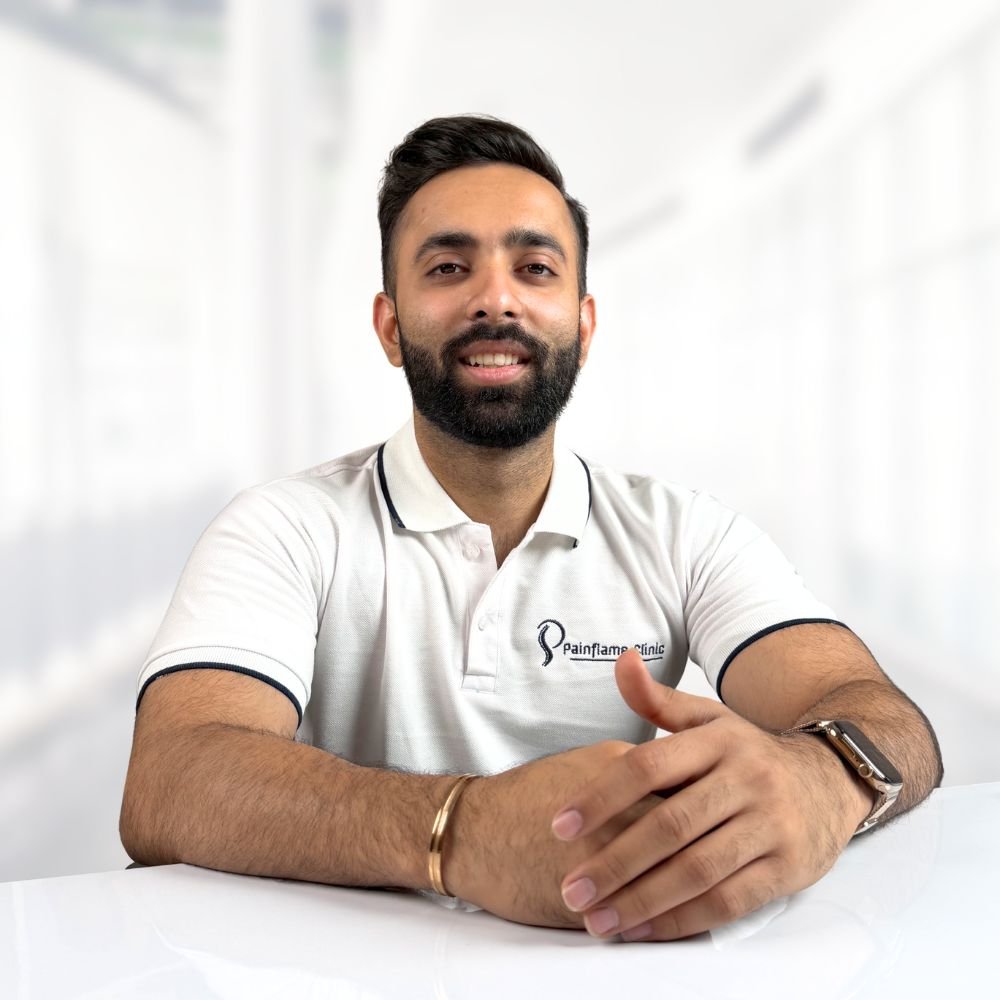
Accurate recovery starts with an accurate assessment. Painflame Clinic, founded and led by Dr. Harish Grover, works with a multi-disciplinary team of sports physiotherapists and chiropractors to develop non-surgical treatment plans built around each patient’s specific athletic demands — not a standardized protocol pulled from a shelf.
At Painflame, the clinical process starts by identifying the root cause: the structural deficits, movement compensations, and loading errors that either caused the injury or are slowing full recovery. That assessment drives everything that follows.
Painflame Clinic serves patients across Delhi NCR, with locations in Gurugram, Paschim Vihar, Noida, and Dwarka. If your injury hasn’t fully resolved — or you want a clear picture of where your recovery actually stands — visit www.painflame.com to learn more.
Frequently Asked Questions
How do I know if my sports injury is fully healed, not just pain-free?
A sports physiotherapist can assess whether you’ve genuinely restored range of motion, limb-to-limb strength, proprioception, and sport-specific movement capacity — none of which pain level alone can confirm.
What happens if I return to sport too early?
Re-injury rates climb substantially — and each recurrence tends to cause greater structural damage than the last, accelerating the kind of joint degeneration that becomes increasingly difficult to reverse.
Is non-surgical treatment genuinely effective for sports injuries?
For most muscle, tendon, and ligament injuries short of complete rupture, non-surgical rehab can produce full functional recovery — though suitability depends on the specific injury and needs a clinical assessment to confirm.
How long does proper recovery take?
It depends on the injury — a well-managed ankle sprain may resolve in 4–6 weeks, while chronic Achilles tendinopathy can take several months or longer depending on how consistently each recovery stage is followed.
When should I stop self-managing and see a specialist?
If swelling persists past 72 hours, you can’t bear full weight, the joint locks or gives way, or you’re feeling numbness or radiating pain, get a clinical assessment rather than waiting it out.